Our last presence at Venus has gone silent
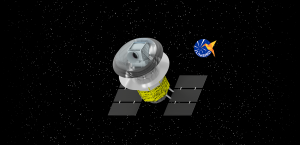
On 29 May 2024, JAXA’s Institute of Space and Astronautical Science announced concerning news. The Akatsuki Venus Climate Orbiter had not been in contact with the team for one month. After over one year of attempting to re-establish communications the inevitable had to be accepted: our last presence at Venus had ended.
For almost ten years, Akatsuki has been the only active spacecraft orbiting our inner neighbour. The spacecraft’s mission was to investigate the climate of Venus, whose sparkling clouds bestowed the name of the goddess of beauty, but below which a dense carbon dioxide atmosphere smothers the surface to drive temperatures that could melt lead.

As the only other Earth-sized planet which we can visit, Venus is an essential puzzle piece in understanding how terrestrial planets can evolve. Equipped with six instruments, Akatsuki was primarily focussed on Venus’s cloud deck, which stretches between 50 – 70 km above the baking surface. In this region, winds whip at speeds that approach the Shinkansen bullet trains, 60 times faster than the planet rotation; a phenomenon that is known as `super rotation’. Before Akatsuki’s arrival, it was unknown how a planet that rotates so sluggishly that a Venusian sidereal day is longer than its year, could drive such terrific winds. Now, we have an idea.
Akatsuki’s beginnings were as dramatic as Venus’s past. Launched in May 2010, Akatsuki was due to enter into orbit around Venus the following December. But the spacecraft missed. A single valve on the fuel line failed, and Akatsuki was not able to manoeuvre into the correct position and velocity to be snagged by Venus’s gravity. The spacecraft shot past the planet, orbiting the Sun as a new tiny planet rather than a moon.

Five years later, Akatsuki approached Venus sufficiently closely to attempt a second orbit insertion. But with the main rocket engine damaged, the team were forced to get creative. The spacecraft would have to attempt capture using the less powerful thrusters that were designed for the tasks of attitude control and fine adjustments. Orbit insertion had never previously been achieved with such a method, but exploration has always been about redefining the impossible.
On 7 December, 2015, Akatsuki successfully entered into orbit around Venus. The instruments gazed at the shining clouds below, and an extraterrestrial weather station was born.
Despite being designed for a 4.5 year lifetime, Akatsuki’s instruments were all functioning. The four cameras imaged the planet in ultraviolet and infrared light, the optical Lightening and Airglow Camera (LAC) hunted for rapid brightness changes that might indicate lightening discharge or airglow phenomena, while the change in frequency of the radio waves generated by the ultra-stable oscillator (USO) and sent through the Venusian atmosphere to Earth revealed details of the vertical temperature profile. Two of the infrared cameras would operate for about a year before taking their last snapshot of the planet, but the remaining four instruments continued to send data as Akatsuki steadily monitored Venus’s incredible climate.
Akatsuki takes an unusual route around Venus, with a retrograde orbit in the equatorial plane of the planet. Satellites typically have a polar orbit, but Akatsuki’s route is particularly good for meteorological science. It was from this viewpoint that Akatsuki spotted a mechanism that could explain super-rotation.
While the solid surface of Venus rotates just once in 243 Earth days, the atmosphere whips around the planet in just 4 Earth days. This super rotation has been known about since the 1960s, but the origin of the source of this continual injection of angular momentum was far less obvious. As Akatsuki gazed steadily at the Venusian surface, researchers mapped the clouds between hundreds of images, measuring their speed as they slid around the globe. This analysis revealed that the acceleration of the clouds depended on the local solar time, suggesting that the incredible rotation speeds were being maintained by solar heating.

This was an intriguing discovery, with consequences extending far beyond our Solar System. Venus’s surface rotation is so slow that the planet is close to being in tidal lock. Like the Moon’s orbit around the Earth, a tidally locked planet would have one hemisphere that always faced the Sun, creating a split world where one side experienced an eternal day, and the other had an everlasting night. Many of the extrasolar planets discovered may be in tidal lock, and there is an ongoing debate as to whether this impedes their chances of habitability. Without a mechanism to redistribute heat, air on the nightside of a tidally locked world would freeze and cause global atmospheric collapse. However, if Venus’s rapid atmosphere rotation is driven by thermal input form the star, then this could be a common mechanism that would redistribute the heat fast enough on tidally locked worlds to save their air.
A second captivating feature spotted by Akatsuki was a structure that resembled a drawn bow etched through the Venusian atmosphere from the northern polar region towards the south pole. End-to-end, this gigantic structure was longer than 10,000 km. Despite the ferocious winds, the bow structure was undisturbed for at least four Earth days. The source is suspected to be the mountain ranges on Venus’s surface pushing the dense lower atmosphere gas to higher altitudes to create a gravity wave. Gravity waves are also seen on the Earth, but have never been observed on this scale.

The connection between the ground topography and the upper atmosphere spotted by Akatsuki underscores the coupling between different regions of a terrestrial planet, from core to upper atmosphere. To truly understand Venus’s environment, we need to unravel the whole planet. This will be the task for the next Venus missions.
In the coming decade, NASA and ESA have proposed plans to send spacecraft to Venus. NASA’s DAVINCI is designed to dive into the Venusian atmosphere, collecting in-situ data as it descends on the temperature, pressure and composition of the atmosphere all the way to the surface. In contrast, NASA’s VERITAS mission is being considered to explore the structure of Venus’s surface and interior from orbit. ESA’s EnVision mission is targeting a launch date in November 2031 and will orbit the planet to monitor the geological circulation system that links atmosphere, surface and interior.

Plans at ISAS include separating out Venus-like and Earth-like planets in other planetary systems. One of the main ways to detect planets is to spot their transit: the tiny dip in starlight as the planet passes in front of the star as seen from Earth. In optical light, the Earth and Venus would have identical transit profiles, as the planet surfaces are approximately the same size. However, in ultraviolet light, they are wildly different sizes as UV light is blocked by the Earth’s very extended exosphere. With a UV telescope, it would be possible to distinguish Earth-like and Venus-like atmospheres, clarifying whether the split between such diversity is driven by orbit alone, or more mechanisms are in play.
Starting at 9am on 18 September 2025, JAXA officially conducted the termination procedure for Akatsuki. To date, 178 journal papers have been published on the Akatsuki mission and using Akatsuki data, and there are more results still to come. This was a mission that changed our view of our Earth-sized neighbour, and laid the path for new discoveries about what it takes to become heaven or hell.
Further information:
The Akatsuki mission website
Press release: Venus Climate Orbiter “Akatsuki” operation completed
The origins of super-rotation:
Cosmos: Akatsuki seeks the source of Venus’s extreme weather
Web release: How waves and turbulence maintain the super-rotation of Venus’ atmosphere
The bow-shaped gravity waves:
Web release: Finding the cause of a bow-shaped feature on Venus: Observations by the Venus Climate Orbiter “Akatsuki” and analysis of numerical simulations
Web release: Appearance of the large bow-shaped feature observed by Akatsuki turned out to be a mysterious phenomenon occurring every Venusian day
 Previous Post
 Next Post