Digging in Mongolia to uncover ice on Mars
Summer is over. As sunlight weakens across the barren landscape, temperatures drop below zero. A meter or so below the ground, liquid water begins to freeze. This unique substance—essential to life—expands as it becomes ice, pushing against the surrounding soil. On the ground above, the terrain cracks.
At the Institute of Space and Astronautical Science, Usui Tomohiro and Hasegawa Hitoshi sit in front of a wall-sized poster depicting a global map of the Martian surface. The discussion between the two Mars scientists is where that red rust landscape might be covering a source of ice. Such knowledge would be a boon for the prospect of human exploration, and Hasegawa might have an answer.
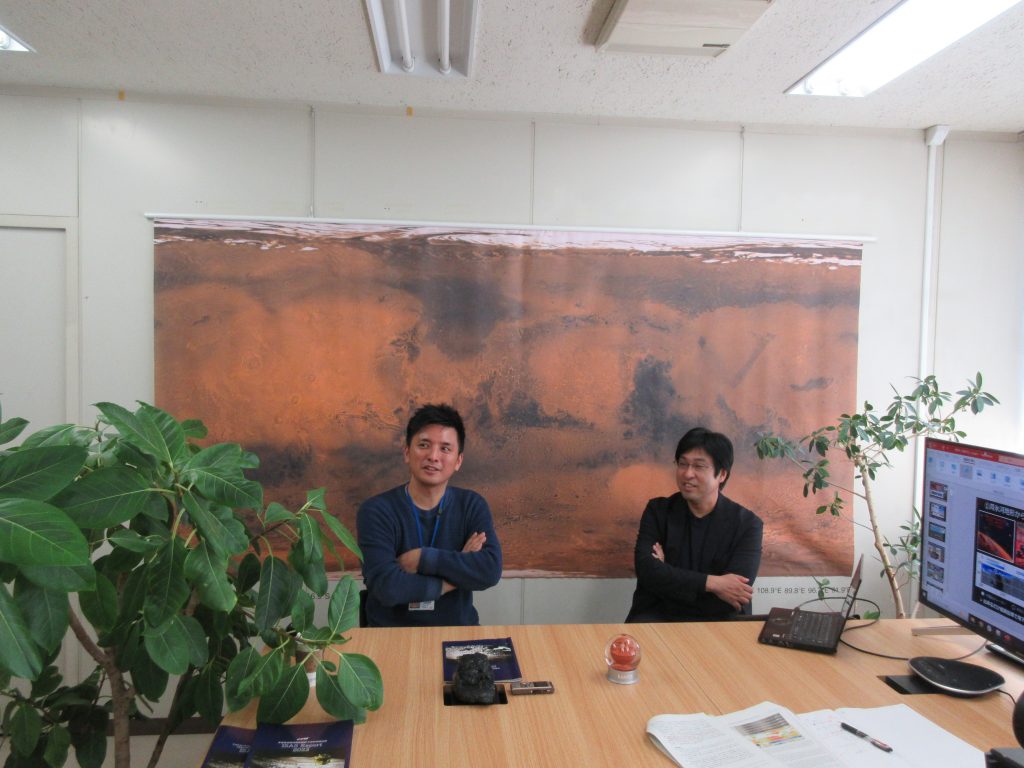
“There are sheets of ice at the poles,” notes Hasegawa, Associate Professor in the Faculty of Science and Technology at Kochi University. “But this area is difficult to explore. Closer to the equatorial region is better, particularly if solar panels are being used to generate electricity.”
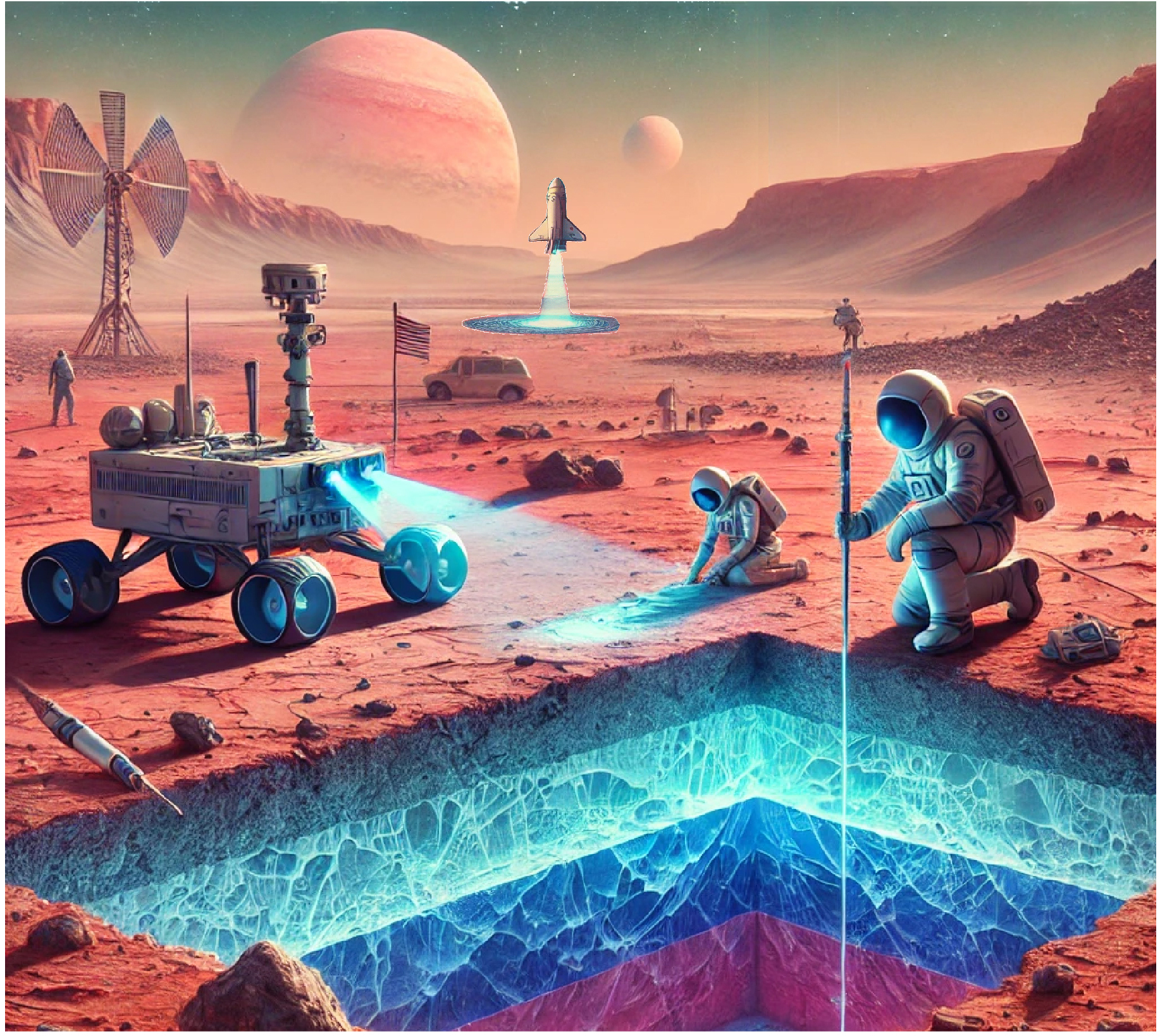
The prospect of human exploration extending outwards from the Moon to Mars is growing in international interest. One challenge is that the travel time to Mars requires a human habitat to survive for extended periods without support from Earth. It is a prospect that would seem significantly more tractable if there was a local source of water.
Mars has visible frozen polar caps that consist of a mix of water ice and frozen carbon dioxide. But the cold temperatures and low levels of sunlight make this the most difficult location to keep essential survival equipment sufficiently warm to operate. At lower latitudes, the thin atmosphere on Mars results in a surface pressure too low for liquid water. Any ice that finds its way onto these marginally sunnier locations quickly sublimates into vapour.
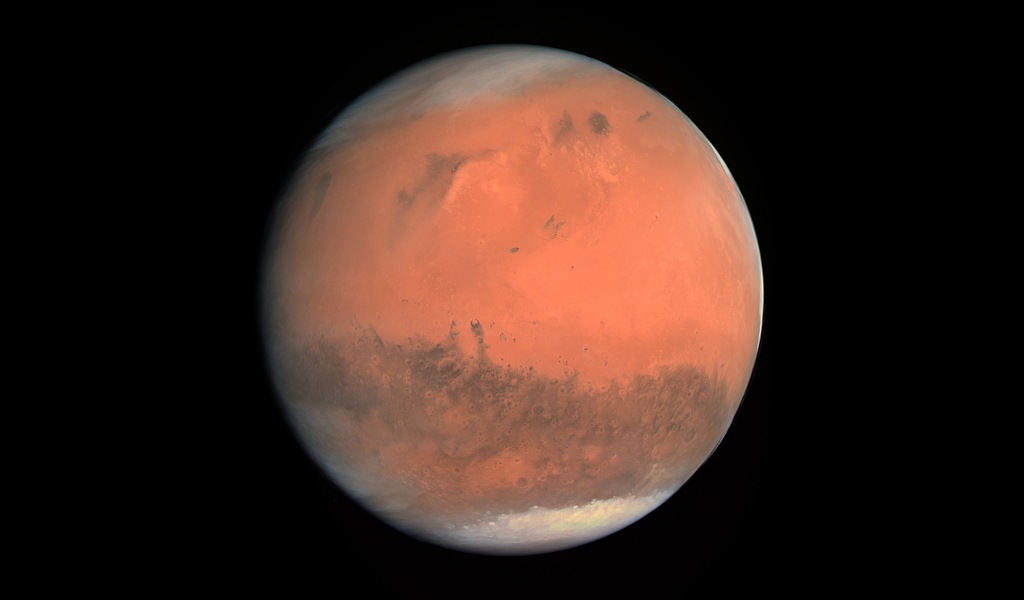
(ESA & MPS for OSIRIS Team MPS/UPD/LAM/IAA/RSSD/INTA/UPM/DASP/IDA).
However, this fate only applies to the Martian surface. There could be ice below the ground, with a top layer of soil providing a protective barrier. If this ice was buried only a few tens of centimetres down, then this could be a viable resource for a human crew.
Evidence that this is no mere pipe dream is both current and historical. The former is direct observation of that ice at the freshly exposed base of new craters. Comparison of craters on Mars with and without ice indicate that ice can exist below the surface of Mars at latitudes down to about 40 degrees. However, since the exposed ice rapidly sublimates, this search technique is limited to a small number of craters that have recently formed. This makes it impossible to know the extent of the distribution of ice down to these more hospitable latitudes, or if it is wide spread versus just the occasional patch.
Historical evidence does hint that the ice could be wide spread. Unlike the Earth, the moons of Mars are small. Neither Phobos nor Deimos are able to exert sufficient gravitational influence on Mars to stabilise the planet’s axial tilt. Mars therefore has wobbled on its axis over the eons, causing the location of the glacial caps to move across the planet’s surface. This has left visible marks on the Martian landscape, with formations that look like they once flowed under the power of a long-absent glacier.

Usui is a Professor in the Department of Solar System Science at ISAS. An expert on Mars geology, he asks if glacial terrain can be seen even at mid-latitudes on Mars, where a human crew might try to land. The formations are proof that ice once existed in this region and could still remain underground.
But although glacial terrain indicates promise, it provides no certainty of a present-day water resource. Etched into the ground hundreds of thousands of years ago, the morphology of the glacial terrain looks the same regardless of whether ice still lingers or not.
“When trying to determine whether there is actually ice today, glacial terrain does not provide that information,” says Hasegawa.
But the sites of past glaciers are not the only formations carved into the Martian ground. Checkerboard patterns of polygons and mounds indicate a type of morphology known as a periglacial feature.
“Ice below the surface will expand in winter, and then contract as it begins to thaw in the summer,” explains Hasegawa. “This underground freeze-thaw cycle causes the terrain on the surface to form distinct patterns as it’s put under stress. These are known as periglacial features.”

The ice below periglacial features may be remnants of past glacial activity, or it could be from water that sublimates from the polar caps in summertime and is drawn below the ground as it precipitates onto lower latitude terrain. Unlike glacial features that are permanently carved into the Martian surface by the passing of a glacier, Hasegawa believes that periglacial features update, depending on the current ice layer below the surface.
Mapping periglacial features across the surface of Mars is the subject of a paper that Hasegawa’s team published in Journal of Geophysical Research Planets. Periglacial features are not large, with one particularly distinctive design consisting of polygons only 10 – 20m in size. Identifying these across the planet surface is possible thanks to the resolution of the HiRISE (High Resolution Imaging Science Experiment) camera onboard the NASA Mars Reconnaissance Orbiter, which has taken snapshots of the surface of Mars at a staggering resolution of 30cm per pixel.
Based on the HiRISE data, periglacial features on Mars are seen down to about 35 degrees, with the greatest density of these features hovering at about 40 degrees. The distribution across the Martian surface is not uniform, but concentrated into three main areas around the Mars globe, with far fewer spotted in Mars’s western hemisphere.
This result is consistent with the ice spotted in freshly exposed crater bases at similar latitudes, supporting Hasegawa’s idea that periglacial features correspond to present day subsurface ice. But are the two phenomena definitely linked?
It turns out that Hasegawa was not originally a Mars scientist. His previous research studied the environmental changes on another planet that is far easier to explore: the Earth.
Polygon structures in Mongolia (Hasegawa Hitoshi).
Back at ISAS, Usui and Hasegawa are watching a movie clip showing a team of people standing in a field. The video zooms outwards and upwards to show that grassland around the group is marked with a polygon structure that looks staggeringly like the periglacial markings on the HiRISE images of Mars.
“It’s a very subtle feature when you’re standing on the ground,” says Hasegawa. “So probably many people are unaware there’s this connected network of periglacial features.”
The video was captured in Mongolia, close to the limit of the permafrost layer where temperatures below the surface remain below zero year round. The boundary of permafrost has shifted as Earth’s climate has changed, altering the surface morphology in a similar way to what Hasegawa suspects has happened on Mars as ice and water retreated from lower latitudes. But unlike on Mars, you can take a shovel and find out what is below the surface.
Usui is particularly interested in this comparison with the Earth. “Earth and planetary science are traditionally quite separate fields,” he says. “I admired the approach by Hasegawa-san to use Earth geology to gain insights into Mars.”

Hasegawa’s previous work in paleoclimatology looked at changes on Earth due to historical warming and cooling. It was a casual suggestion during a seminar that cause Hasegawa to wonder if his studies could be applied to Mars.
“I was researching sand dunes in the deserts on Earth,” Hasegawa recalls. “Dunes are created from sand deposited by wind, and their formation can be used to reconstruct past wind flows. I thought this could also be used to identify where deserts used to be located in the past, when the Earth’s climate was different.”
It was during a presentation on this work that Hasegawa was asked if he had considered applying this knowledge to the dune formations on Mars. It would be a career turning point for Hasegawa, who began examining more Earth analogue sites, where conditions resemble that on other planetary bodies.
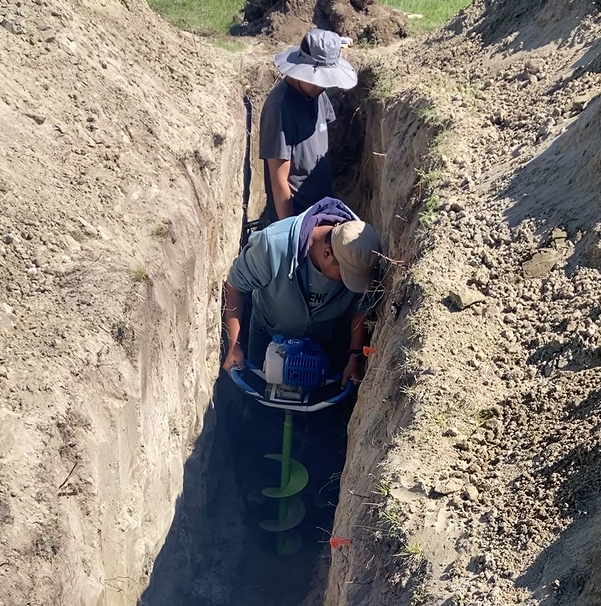
In Mongolia, the team began to dig. If the periglacial features were always due to the underground ice spotted at the bottom of recent Mars craters, the team should hit frozen found about 1m down. In fact, the team reached ice at 1.8m. It was deeper than expected, but the experiment had been performed in summer time, where ice would be at its lowest abundance. The periglacial features did indeed seem to indicate subsurface ice, and the depth might be similar on both the Earth and Mars. But unlike glacial features, could periglacial features be trusted to only reflect current ice?
Putting shovels aside, Hasegawa turned to Google Earth and began to examine the satellite imagery, looking for similar polygon periglacial features.
“Google Earth seems like a simply tool,” comments Usui. “But this is an example where the team had visited one site in Mongolia, and so understood the characteristics of the periglacial patterns very well. It was then possible to spot these same features at the resolution offered by Google Earth.”
Hasegawa’s team noticed that periglacial polygons appeared in areas of permafrost, but not where the permafrost has retreated to higher latitudes. Moreover, there were regions with sharp cracks and pockmarks had appeared in the polygon structure. These worn features were at the southern limit of the permafrost, suggesting that the periglacial feature rapidly degraded once the ice had gone.

“We discovered that the periglacial features only occurred in the permafrost areas,” says Hasegawa. “In non-permafrost areas, even at the same latitude, these features were missing. This gave us confidence that the periglacial features correspond only to present day ice.”
The worn periglacial features had also been seen in the images of Mars. It was these that would provide a final piece of evidence that Hasagawa needed to be convinced they were identifying sites of current ice under the Martian terrain.
Climate models of Mars predict where water vapour that sublimates from the frozen ice caps is carried and deposited by the thin atmosphere. Areas packed with periglacial features match regions where models suggest snow falls and may been pulled underground. Moreover, comparisons with models of an earlier Mars when the planet’s axial tilt was significantly higher, show that the degraded periglacial features sit where water once fell in the past, but not the present day.
“The degraded periglacial features correspond to where there was intense accumulation of ice when Mars had a high obliquity,” explains Hasegawa. “But not in the present day.”
The evidence for periglacial features tracing subsurface ice is convincing, but the final proof would be to dig into Mars itself to find the ice. Hasegawa believes that a penetrator could be used to expose ice at periglacial sites. However, planetary protection issues would need to be carefully considered.
Usui notes that Hasegawa’s experience with applying ground studies of the Mongolian periglacial features to satellite images could also be applied on Mars. A closer look at the periglacial features from the Martian surface with a lander could aid further identification of these features using satellite exploration. It would be another lesson learned from Earth applicable to Martian science.
Another option would be to search for the ice via radar. This was a task that was given to the International Ice Mapper Mission (IMIM), that was a proposed Martian orbiter to be launched by the US, Japan, Canada and Italy. However, plans for IMIM are currently postponed.
Meanwhile, Hasegawa is once again considering dunes. Surrounding the north polar ice cap on Mars are dunes made from gypsum. Hasegawa suspects that these may be related to a sub-glacial lake that lurks beneath the ice cap.
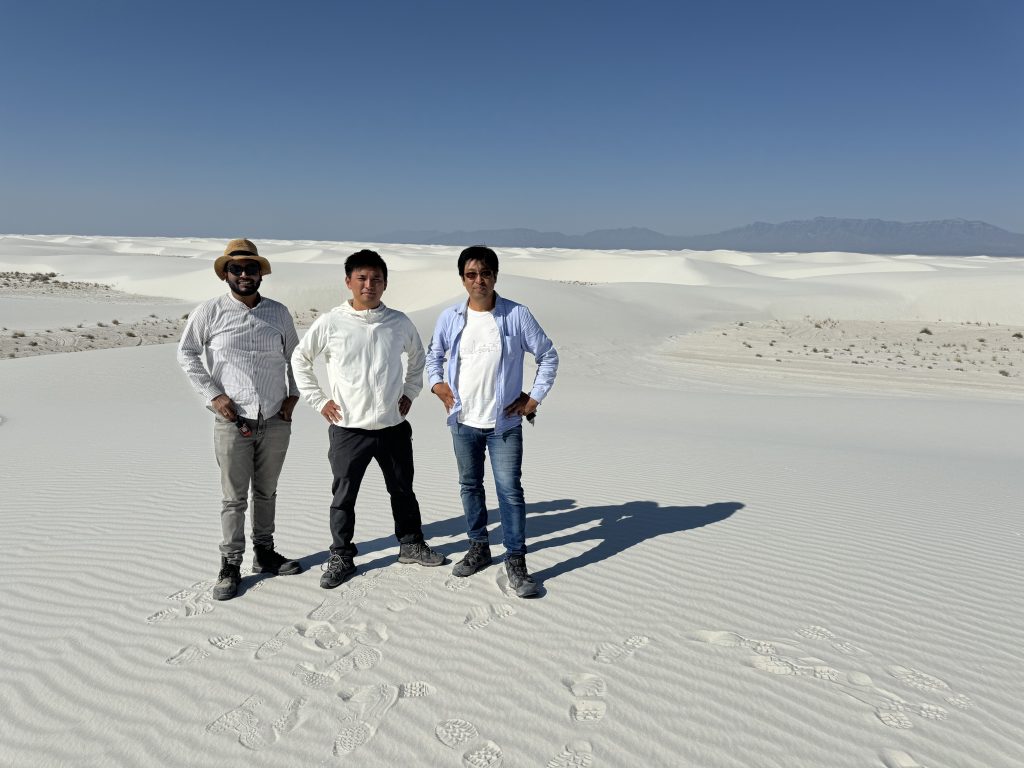
Similar gypsum dunes also exist on Earth, with the largest sprawling across New Mexico, USA. Hasegawa has recently visited the site to try and understand these formations on both planets.
This time, Usui travelled with him.
Further information
Journal paper:
“The Periglacial Landforms and Estimated Subsurface Ice Distribution in the Northern Mid-Latitude of Mars“, Sako, Hasegawa, Ruj, Komatsu, Sekine, December 2024, JGR Planets
SPACE Laboratory at ISAS JAXA (Usui group)
 Previous Post
 Next Post